Hail and wind in the Treasure Valley: what they do to a roof and when to file
The valley doesn't get Texas hail. It gets inch hail on 20-year-old shingles and 60 mph outflow winds on unsealed tabs, which does the same job more slowly. Here's how to read a roof after a storm.
The storm calendar
Treasure Valley severe weather is a warm-season problem. From May into early August, hot afternoons build thunderstorms over the Owyhees to the southwest and the Boise Front to the north, and the storms push across the valley floor with outflow winds, cloudbursts and hail. The two events of 2026 are the pattern in miniature. On May 25, gusts near 60 mph tore the roof off the Alaska Air Cargo building at the Boise Airport, delayed flights and knocked out power. On June 27, Meridian took soft hail for most of an hour between 8 and 9 PM, Caldwell got more than an inch of rain in about fifteen minutes, Kuna and Middleton each got about an inch, streets flooded as the hail melted, and Canyon County declared a local disaster emergency. Spring and fall add a second wind season, when Pacific fronts push 45–60 mph gusts down the valley with no storm at all.
What hail does to a shingle
An asphalt shingle is a fiberglass mat coated in asphalt and covered in mineral granules. A hailstone that hits hard enough knocks the granules loose and bruises the mat underneath — a soft spot you can feel with a thumb — without tearing anything you'd see from the ground. Sun then bakes the exposed asphalt, it dries and cracks, and a year or two later the crack goes through and the leak begins, usually during a January thaw when the ice dam backs water up to it. On a healthy architectural shingle it takes about 1¼-inch hail to bruise. On a brittle 15- to 20-year-old three-tab — which is most of Meridian, built between 2002 and 2008 — an inch does it, and inch hail is what the valley gets.
What wind does
Wind damage is different: it lifts and creases the tab along the seal line, breaks the seal, and tears the tab off in the next gust. It starts on the west- and south-facing slopes that face the valley wind and on the first course at the eave, and it's far worse on roofs that were installed in cold weather without hand-sealing, or with four nails instead of six. On a brittle old roof a creased tab won't lie back down and reseal — it breaks. After a windstorm, look for shingles in the yard, lifted tabs you can see from the ground, and exposed nail heads at the ridge.
The test square
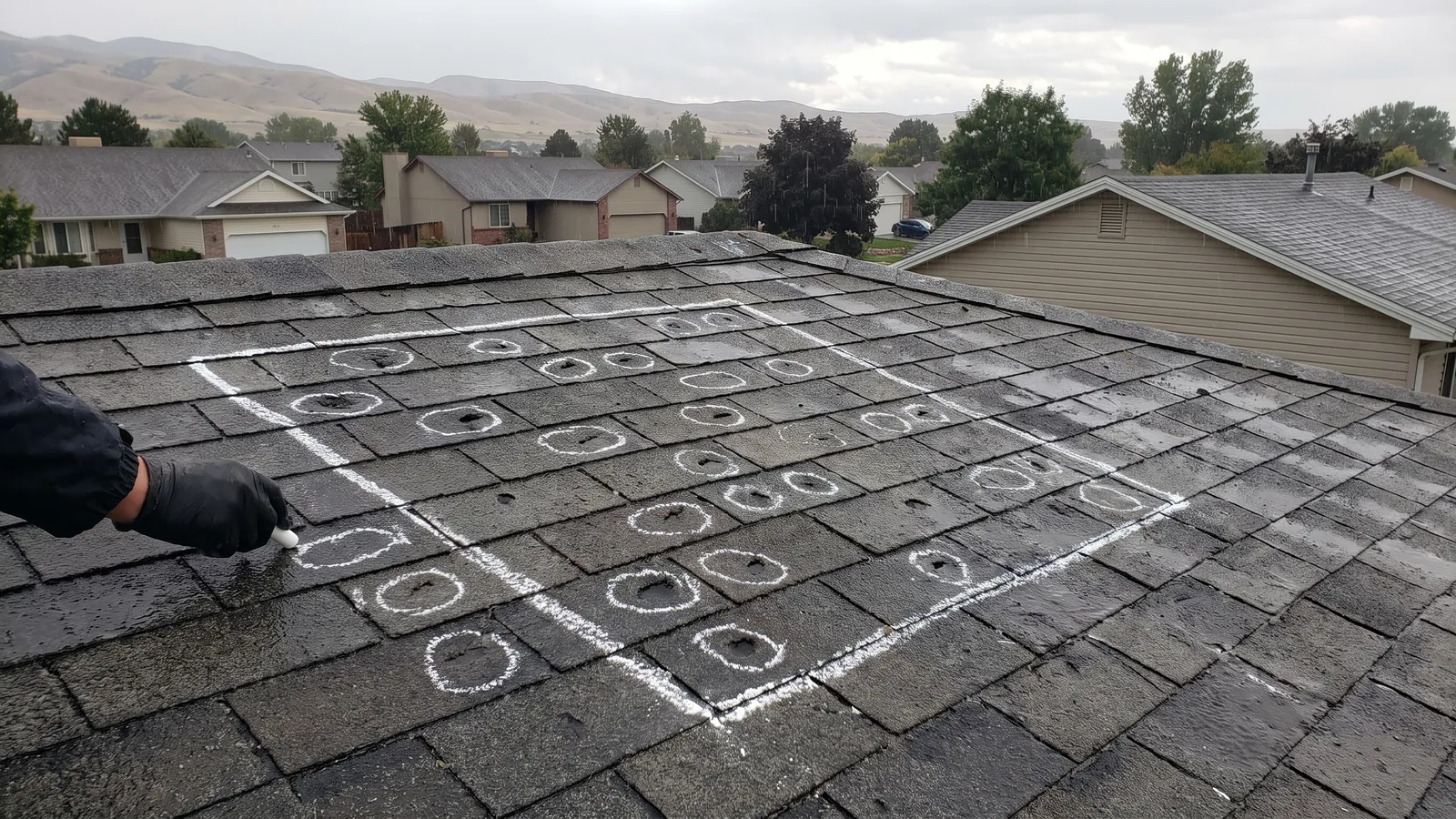
The only honest way to assess hail is the same way adjusters do it: a 10-by-10-foot square chalked on each slope, every hit inside it circled and counted, photographed with the date. Soft metals — gutters, vent caps, AC fins, window screens — are checked too, because they dent at hail sizes that don't hurt shingles and they confirm the storm hit the house. A few hits is a repair. Eight or more per square on most slopes is a replacement, and most Idaho carriers use a threshold in that range. The inspection is free, and you keep the photos either way.
When to file
File when the documented damage exceeds your deductible by enough to matter — and check the deductible first, because many Idaho policies now carry a separate wind/hail deductible of 1% or 2% of the dwelling coverage, which on a $450,000 policy is $4,500 to $9,000. Don't file for a $600 repair. Do file promptly for a roof-wide hail event, because bruises are easier to attribute to a specific storm before the next storm muddies the picture, and because a bruised roof that's left two years becomes "wear" in an adjuster's write-up. And never let a contractor file for you or sign an assignment of benefits; in Idaho you file, you're the client, and the contractor documents and builds.
The 2002–2008 problem
Meridian added roughly 80,000 people between 2000 and 2010, most of them in houses built between 2002 and 2008 with builder-grade three-tab shingles rated for 20–25 years. In this valley — 206 sunny days, single-digit humidity, dozens of freeze-thaw cycles a winter — they reach the low end. Those roofs are now 18 to 24 years old and brittle, which means the hail that would have bounced off in 2010 breaks them now, and the wind that would have resealed a tab now tears it. If your house went up in that window and a storm crossed it this year, get it looked at.
Common questions
Does hail damage always show from the ground?
Almost never. Bruises are invisible from the yard, and creased shingles lie back down. What you can see from the ground — dented gutters and vent caps, granules in the downspout, shingles in the yard — tells you to have the roof checked, not what the roof looks like.
Will a claim raise my rates?
It can, and a filed claim goes on the home's claims history whether it's paid or not. That's why we quote the repair first and tell you when a claim isn't worth filing.
Can hail damage be repaired instead of replaced?
A few hits on one slope, yes — those shingles are replaced. Damage across most slopes, no: the bruised shingles are all going to fail on the same schedule, and a patchwork of new shingles on a brittle roof doesn't hold.
Is a Class 4 shingle really hail-proof?
It's hail-resistant: it passes a test that mimics inch-and-a-half hail without cracking. Big hail can still mark it. In this valley, where inch hail on old shingles is the problem, Class 4 nearly eliminates it, and many carriers discount the premium for it.
Related: Hail & wind damage service · Roof insurance claims · Class 4 shingles · Idaho insurance claims guide